Business Automation: Streamlining Operations for Sustainable Growth
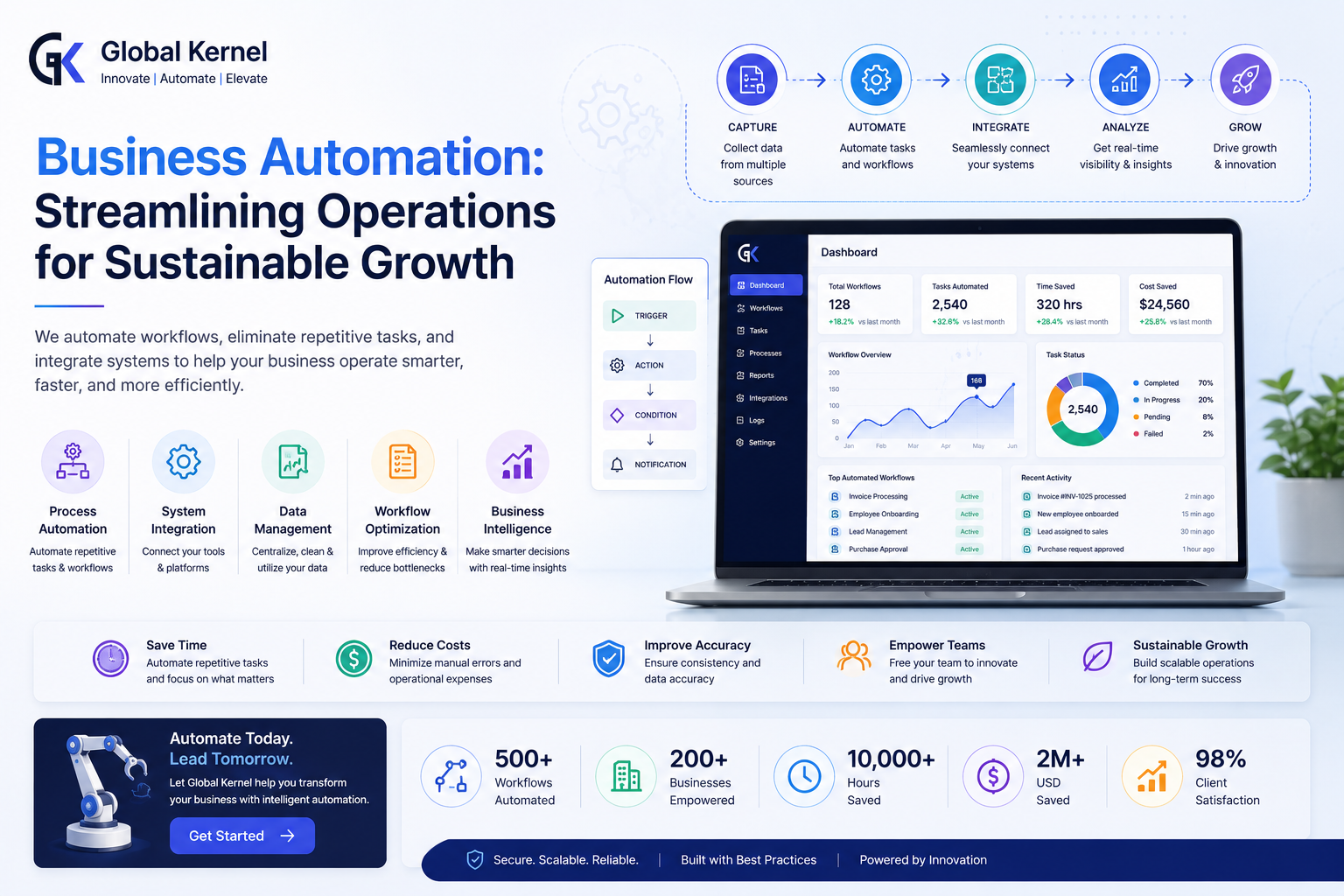
Business automation has evolved from a competitive advantage to a business necessity. Organizations that embrace automation gain significant advantages in efficiency, accuracy, and scalability. This comprehensive guide explores how business automation can streamline your operations and drive sustainable growth.
Understanding Business Automation
Business automation involves using technology to automate repetitive, rule-based tasks and processes. This ranges from simple task automation, such as automated email responses, to complex process automation that spans multiple systems and departments. The goal is not to replace human workers but to free them from mundane tasks so they can focus on higher-value activities that require creativity, judgment, and human interaction.
The scope of business automation has expanded dramatically with advances in artificial intelligence, machine learning, and robotic process automation (RPA). Modern automation platforms can handle unstructured data, make decisions based on complex rules, and learn from historical patterns to improve over time.
Key Areas for Automation
Finance and accounting are prime candidates for automation. Invoice processing, expense reporting, reconciliation, and financial reporting can be automated to reduce errors and accelerate financial close processes. Organizations typically see 60-80% reduction in processing time for automated financial workflows.
Customer service automation using chatbots, automated ticket routing, and self-service portals can significantly improve response times while reducing support costs. AI-powered chatbots can handle up to 80% of routine inquiries, allowing human agents to focus on complex issues that require empathy and expertise.
Human resources processes including employee onboarding, leave management, performance reviews, and benefits administration are well-suited for automation. Automated HR workflows ensure consistency, compliance, and a better employee experience.
Supply chain and inventory management benefit enormously from automation. Automated reorder points, supplier communication, and inventory tracking reduce stockouts and overstock situations. Integration with supplier systems enables just-in-time inventory management.
Implementing Automation Successfully
Successful automation implementation requires a strategic approach. Start by identifying processes that are repetitive, rule-based, and high-volume. These processes offer the greatest return on automation investment. Map the current process in detail, including all inputs, outputs, decision points, and exceptions.
Choose the right automation technology for each process. Simple task automation can be implemented with workflow tools. Complex processes may require BPM (Business Process Management) platforms or RPA. Data-intensive processes benefit from AI and machine learning capabilities.
Change management is critical for automation success. Employees need to understand that automation is designed to help them, not replace them. Involve affected teams in the automation design process to ensure that automated workflows reflect real-world requirements and gain user buy-in.
Measuring Automation ROI
Measuring the return on automation investment requires tracking both quantitative and qualitative benefits. Quantitative metrics include processing time reduction, error rate reduction, cost savings, and throughput improvement. Qualitative benefits include employee satisfaction, customer experience improvement, and strategic capability enhancement.
Most organizations achieve positive ROI within 6-12 months of implementing automation. The key is to start with high-impact processes and expand gradually based on demonstrated results.
Conclusion
Business automation is no longer optional for organizations that want to remain competitive. By strategically automating key processes, businesses can achieve significant efficiency gains, reduce errors, and free their teams to focus on activities that drive growth and innovation.
Ready to Automate Your Business Processes?
Global Kernel helps businesses identify and implement automation opportunities that deliver real results. Contact us for a consultation.
Request a Quote →